 Skip to content
Philosophical Abstractions
Stone Machines and the Lost Interface
There are ancient things that do not feel dead.
Not because they are mysterious in the cheap way. Not because the internet has learned how to turn every shadow into a theory. I mean something quieter than that. Something more difficult to explain.
A stone chamber. A pyramid. A passage aligned to a star. A block too large to look reasonable. A wall fitted so tightly it feels less built than persuaded into place. A shape carved into the earth that only becomes visible from above. These things bother me because they do not behave like ordinary leftovers.
A broken pot is a leftover.
A tool is a leftover.
A collapsed wall is a leftover.
But some artifacts feel like they are still participating in something.
They sit there, silent, but not empty. Something has stopped moving, maybe, but the pressure remains. You can feel the missing part.
That is where my mind goes.
Not immediately to aliens. Not immediately to secret lasers. Not immediately to some lost metal more advanced than anything we have now. Those explanations feel too eager to escape the human problem. They replace one mystery with another and then act like the matter has been solved.
The real mystery, to me, is stranger.
What if some ancient machines do not register as machines because the missing component was never made of stone?
The body.
The ritual.
The priesthood.
The sound.
The calendar.
The myth.
The arrangement of people.
The state of consciousness.
The reality framework.
Modern people see stone and ask where the engine is. But the engine may never have been located in one place. It may have been distributed across the civilization itself.
Maybe the machine was stone plus body.
Stone plus chant.
Stone plus astronomical timing.
Stone plus social hierarchy.
Stone plus terror.
Stone plus reverence.
Stone plus the belief that the world was not made of dead matter, but of living order.
Remove all of that and the artifact becomes mute.
Not useless. Mute.
There is a difference.
In Star Wars, there was a species called the Rakata. Their civilization was built around the Force. Not only spiritually. Not only symbolically. Their machines were built through it. Their empire, their tools, their weapons, their infrastructure, their whole operating logic depended on Force-sensitivity.
The Force was not an accessory to their world.
It was the interface.
That is the important part.
Their technology assumed a kind of being. It assumed that the user had an internal organ of reality that could meet the machine halfway. So if that sensitivity disappeared, the machine did not necessarily break in the ordinary sense. The object might still be there. The walls might still stand. The device might still be intact.
But the civilization would no longer know how to touch it.
The interface would be gone.
That fictional idea opens a real philosophical wound.
Because we tend to assume that technology is neutral. A lever works for anyone. A wheel turns for anyone. A switch does not care who presses it. Modern machinery is built around this assumption. The user may need training, but the machine itself is not supposed to require a soul.
But human beings have never only built machines like that.
A court turns conflict into judgment.
A church turns fear into reverence.
A flag turns cloth into nation.
Money turns trust into power.
A uniform turns a body into authority.
A wedding ring turns metal into vow.
None of these machines work unless the civilization knows how to read them.
That is the part we forget.
The modern mind wants the machine to be mechanical because mechanical things are easier to interrogate. You can measure them. You can break them open. You can find the gear, the circuit, the pressure point, the energy source. Symbolic machinery is harder because its energy source is not only physical. It is participation.
Participation is not imaginary.
It is one of the strongest forces human beings have ever produced.
A pyramid is not only stone stacked upward. It is a society arranged around death, kingship, labor, astronomy, divine order, mathematics, agriculture, fear, and immortality. It is a political object. It is a religious object. It is an engineering object. It is a psychological object. It is a social object.
But calling it an object may already be too small.
Maybe it is better to call it a compression.
A civilization compressed into stone.
That is what I mean by artistic abstractions of reality.
Art is not decoration. That is one of the laziest modern reductions. Art is not the pretty layer placed on top of the real thing after the engineers and priests and accountants are done. Art is one of the ways reality becomes graspable to human beings.
Art takes the invisible pressure of a civilization and gives it a body.
Sometimes the body is a painting.
Sometimes it is a poem.
Sometimes it is a law.
Sometimes it is a ritual.
Sometimes it is a machine.
Sometimes it is a mountain of stone built so precisely that thousands of years later we are still arguing with it.
When we look at ancient Egypt, we often ask the question our age is trained to ask: how did they build it?
That is a legitimate question. It should not be dismissed. Stones were moved. Angles were calculated. Materials were cut, dragged, raised, polished, aligned. There were physical processes, and those processes matter.
But I do not think the engineering question exhausts the artifact.
It might not even be the deepest question.
The deeper question is: what kind of reality made this construction feel necessary?
Because civilizations do not spend enormous amounts of labor on what they secretly believe is meaningless. They spend themselves on what they believe is most real.
That is the rule I keep circling back to.
Every civilization builds its technologies around what it believes is most real.
If matter is most real, it builds engines, cranes, laboratories, weapons.
If information is most real, it builds code, databases, prediction systems.
If profit is most real, it builds markets and calls them natural.
If safety is most real, it builds surveillance and calls it care.
If speed is most real, it builds acceleration into every corner of life and calls stillness failure.
If death is most real, it builds tombs.
If the gods are most real, it builds temples.
If cosmic order is most real, it aligns architecture to the heavens.
This is not a minor difference in taste. It changes what a civilization can even notice.
We think we are more rational because we separate things. Religion over here. Science over there. Art in another room. Government in its own building. Architecture as a profession. Mathematics as a discipline. Death as a medical event. The sky as data. Matter as resource.
The ancient world did not always suffer from that separation. Or it suffered from different separations. The point is not that they were purer. The point is that their categories were not ours.
So when we call something "unexplainable," sometimes what we really mean is: unexplainable inside our current categories.
That is a different thing.
And it matters.
Because categories are not passive. They are tools. They are filters. They decide what can be asked. They decide what counts as an answer. They decide what appears primitive and what appears advanced.
To a modern industrial mind, a pyramid may look like a bizarre waste of labor unless we can translate it into engineering, astronomy, or political control.
But to the civilization that built it, the pyramid may have been the opposite of waste. It may have been the shape of order itself.
Not a tomb only.
Not a monument only.
Not a calendar only.
Not a machine only.
Not a symbol only.
Something more total than our separated words can comfortably hold.
That is where the Rakatan metaphor becomes useful. Not because it proves anything about Egypt. It does not. Fiction should not be mistaken for evidence. But fiction can sometimes give philosophy a better handle.
The Rakata imagined technology that required attunement.
That is the word I want.
Attunement.
Not belief as mere opinion. Not superstition as failed science. Attunement as a way of being organized toward reality.
A person can be trained to read a musical score, but that does not mean the paper itself makes music. A person can look at a legal document and see ordinary words, while a lawyer sees power moving through language. A priest can look at a ritual object and see an active instrument, while a tourist sees a carved thing in a glass case.
The object did not change.
The interface changed.
That may be what loss really means.
Not that the stones are gone. The stones survived.
The human arrangement that made them fully legible did not.
And because we inherit the material shell without the full operating system, we either flatten the artifact into engineering or inflate it into fantasy.
Both reactions are understandable.
Both are incomplete.
The artifact deserves something harder from us.
It deserves the humility to say: this may have worked in a way we no longer know how to recognize.
That does not mean it violated physics.
It may have violated our expectations.
It may have violated our categories.
Sometimes that is more disturbing than violating physics, because physics belongs to the world. Categories belong to us. When an ancient object defeats our categories, it reveals the limits of the mind holding the measuring tape.
That is why ancient stone feels philosophical to me.
Stone is the material of stubborn memory. It does not care what century is looking at it. It outlives the language that named it. It outlives the empire that ordered it. It outlives the workers, the priests, the kings, the skeptics, the believers, the invaders, the restorers, the photographers, the tour buses, the documentaries.
Stone remains.
But meaning does not remain in the same way.
Meaning has to be carried by living systems. By bodies. By speech. By repetition. By initiation. By fear. By desire. By authority. By apprenticeship. By the small daily acts that teach a person what kind of world they are inside.
When those systems die, meaning does not disappear all at once.
It leaks.
It thins.
It becomes archaeological.
Then the artifact becomes a mirror.
The engineer sees engineering.
The mystic sees initiation.
The nationalist sees glory.
The skeptic sees fraud.
The believer sees proof.
The tourist sees spectacle.
The philosopher sees a question that will not sit down:
How much of reality is made visible by the form of attention we bring to it?
This is not relativism. I am not saying anything can mean anything. Stone has weight. Geometry has constraint. Labor has cost. Bodies get tired. Ropes break. Tools leave marks. Stars move according to patterns not invented by priests.
Reality pushes back.
But human beings do not encounter that push raw. We encounter it through frames. Through trained perception. Through metaphors so deep we forget they are metaphors. Through inherited agreements about what is real enough to deserve our lives.
That is why our own machines will look strange one day.
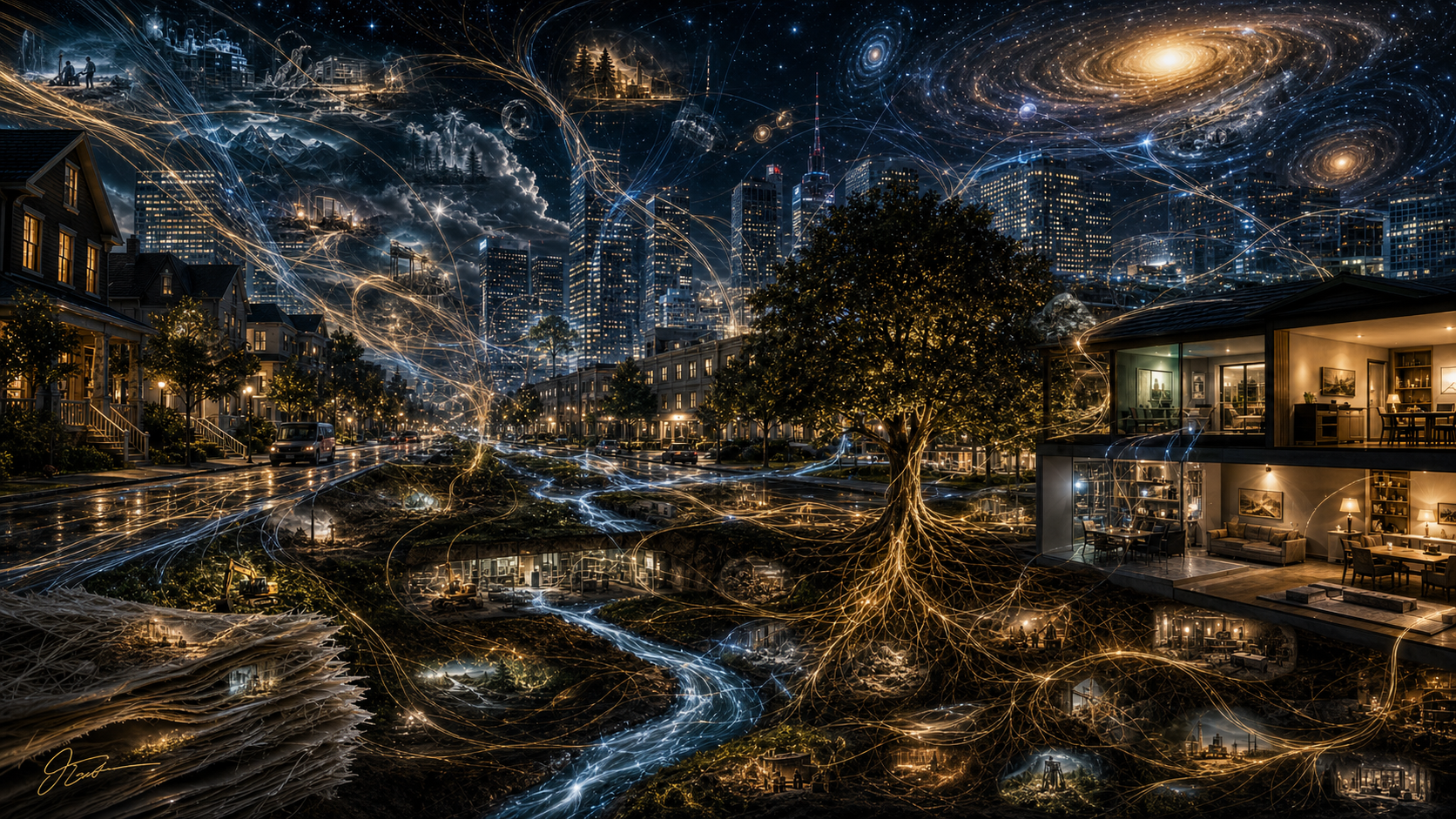
Imagine a future civilization finding our server farms after the grid is gone. Endless rooms of dead metal boxes. Wires. cooling systems. empty racks. Glyphs etched into boards. Strange glass rectangles. They may ask: what were these temples for?
And they would not be completely wrong.
We built cathedrals for information.
We built priesthoods of code.
We built rituals of authentication.
We built identities that only existed because machines recognized them.
We built economies around invisible numbers moving through invisible networks at impossible speeds.
We built lives around the belief that data could make reality obedient.
Then imagine the interface disappears.
No electricity.
No protocols.
No passwords.
No institutions that honor the numbers.
No trained users.
No shared faith in the screen.
The device remains, but the world that made it powerful is gone.
A future archaeologist may hold a smartphone and call it a ceremonial mirror.
And maybe, in a way, they would be right.
This is why I do not want to laugh too quickly at ancient people, or at the people trying to make sense of ancient artifacts now. The impulse behind the speculation is not always stupidity. Sometimes it is awe without discipline. Sometimes it is the mind trying to account for a pressure it genuinely feels.
The danger is when awe becomes lazy.
The equal danger is when skepticism becomes small.
Good philosophy has to stay between those failures. It has to keep wonder alive without surrendering to nonsense. It has to keep reason sharp without using it as a weapon against mystery.
That is the line I want to walk in this book.
Artistic abstractions of reality are not escapes from the real. They are attempts to hold reality at the level where human beings actually live.
We do not live inside physics alone.
We live inside physics plus language.
Physics plus memory.
Physics plus fear.
Physics plus hunger.
Physics plus beauty.
Physics plus death.
Physics plus story.
Physics plus the terrible human need for the world to mean something before it ends.
The ancients knew this, perhaps not as a thesis but as a condition. Their machines may have been built at the intersection of matter and meaning because they did not yet imagine those as enemies.
That may be the real lost technology.
Not levitation.
Not impossible saws.
Not hidden engines.
The lost technology may be the ability to build in a way that did not separate function from cosmos.
To build a structure that was useful, symbolic, political, spiritual, astronomical, artistic, and psychological all at once.
To make a thing that did not merely do something, but gathered a world.
We have our own version of this, but we usually refuse to admit it. We pretend our systems are clean and rational because their myths are written in technical language. But a market has mythology. A court has mythology. A corporation has mythology. A nation has mythology. A software platform has mythology.
The myth does not become less mythic because it has a dashboard.
So the ancient stone machine is not an embarrassment to modern intelligence. It is a challenge to it.
It asks whether we have mistaken explanation for understanding.
It asks whether the real function of an artifact can survive the death of the civilization that made it.
It asks whether a machine can keep operating after its original purpose is gone, simply by continuing to transform the minds that encounter it.
Because the pyramids still work in that sense.
Stonehenge still works.
The old temples still work.
The carved chambers still work.
They produce attention. They produce argument. They produce reverence. They produce theories. They produce humility. They produce the uneasy feeling that our present way of dividing the world may not be final.
That may be enough to call them machines.
Not because gears are hidden inside them.
Because they still transform input into output.
We bring them certainty.
They return uncertainty.
We bring them categories.
They return fracture lines.
We bring them the arrogance of the present.
They return scale.
That is the strange mercy of stone. It slows the mind down. It refuses our speed. It makes us stand in front of something that did not need us to understand it in order to survive us.
And maybe that is why these artifacts continue to bother me.
They are not just ancient.
They are accusations.
They accuse the present of being too narrow.
They accuse our machines of being too shallow.
They accuse our explanations of being too satisfied with themselves.
They remind us that a civilization is not only known by what it can build, but by what it believes is worth building.
And if that is true, then the question turns back on us.
Not what did the ancients believe?
Not how did they move the stone?
Not what secret did they lose?
But what are we building around?
What do our machines reveal about our gods?
What invisible thing have we mistaken for reality so completely that we no longer see it as belief?
That is where the chapter has to end for now. Not with an answer. Answers come too quickly when the question is alive.
For now, I only want to hold the possibility open:
A machine made of stone may not move.
It may move us.
And maybe movement of that kind is not a metaphor.
Maybe it is the oldest technology we have.